
Let’s be honest: bookkeeping usually gets done the same way a lot of people deal with the laundry. You know it needs attention, you mean to stay on top of it, and then suddenly there’s a giant pile staring back at you.
One week gets busy. Then another. Before long, your bank feed is full, receipts are floating around the ute, your invoices need chasing, and you’re opening QuickBooks with the same energy people bring to a dental appointment.
The good news? It doesn’t have to be like that.
QuickBooks works best when it supports a weekly rhythm, not a once-a-month panic session. And for small business owners who are busy, practical, and not keen to become accidental accountants, that rhythm can make a massive difference.
Most owners think the issue is the software, the reports, or the admin itself.
Usually, it’s not.
The real issue is inconsistency.
When bookkeeping gets pushed to the end of the month, small mistakes pile up quietly. One transaction gets coded wrong. A supplier bill is missed. A receipt goes missing. A payroll item is entered incorrectly. Then you sit down weeks later and try to reconstruct what happened.
That’s like trying to clean the whole house five minutes before visitors arrive. Technically possible. Emotionally unpleasant.
A weekly routine inside QuickBooks keeps things moving while they’re still manageable. That’s where the transformation happens.
Monthly bookkeeping feels efficient on paper, but in real life it creates backlog, guesswork, and stress.
Weekly bookkeeping works better because:
Think of it like brushing your teeth. A few minutes every day is simple. Ignoring it for weeks creates a much bigger problem.
That same logic applies to QuickBooks bookkeeping. Small, regular actions beat heroic catch-up sessions every single time.
“Clean books” sounds technical, but it really just means your numbers aren’t lying to you.
Clean books mean:
That’s what gives you confidence. Not fancy spreadsheets. Not jargon. Just clear, believable numbers.
For business owners who want a simpler, more human routine around this, Small Company Bookkeeper can be a helpful place to explore practical finance habits.
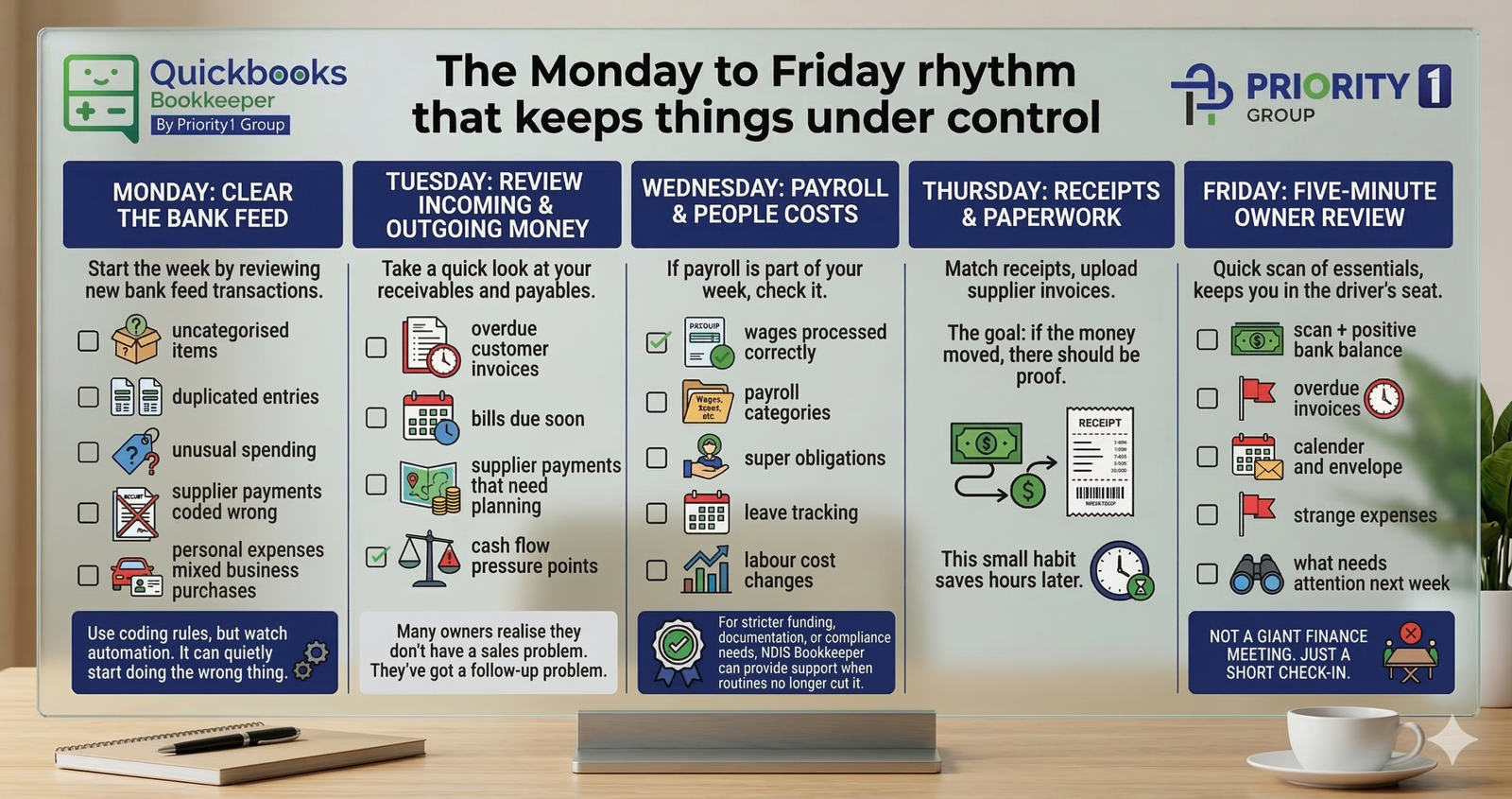
You don’t need a huge block of time. You need a repeatable flow.
Start the week by reviewing new bank feed transactions.
Check for:
Use coding rules for repeat transactions, but keep an eye on them. Automation is helpful until it quietly starts doing the wrong thing.
Take a quick look at your receivables and payables.
Focus on:
This is where a lot of owners realise they don’t actually have a sales problem. They’ve got a follow-up problem.
If payroll is part of your week, this is the day to check it.
Review:
For businesses with stricter funding, documentation, or compliance needs, NDIS Bookkeeper can be a strong support option when standard routines no longer cut it.
This is your admin tidy-up day.
Match receipts, upload supplier invoices, and make sure major transactions have backup. The goal is simple: if the money moved, there should be proof.
This small habit saves hours later.
Finish the week with a quick scan of the essentials:
That’s it. Not a giant finance meeting. Just a short check-in that keeps you in the driver’s seat.
You do not need to track everything. You just need to know what deserves your attention fast.
Watch for these warning signs:
When these signs show up, act that week. Waiting rarely makes bookkeeping problems smaller.
No, you do not need to prepare a BAS every Friday.
But you do need habits that make BAS time less painful.
That includes:
This is the sort of thing a Myob Bookkeepers helps set up properly from the start. The goal is not just compliance. It’s less stress.
Receipts are boring until you need one and can’t find it.
A solid documentation routine should be:
The rule is simple: don’t trust your memory.
That coffee meeting, tool purchase, software subscription, or contractor invoice might seem obvious today. Three weeks later, not so much.
A capable QuickBooks Bookkeeper can often sort out messy records, but it’s much cheaper and easier to build the habit early.
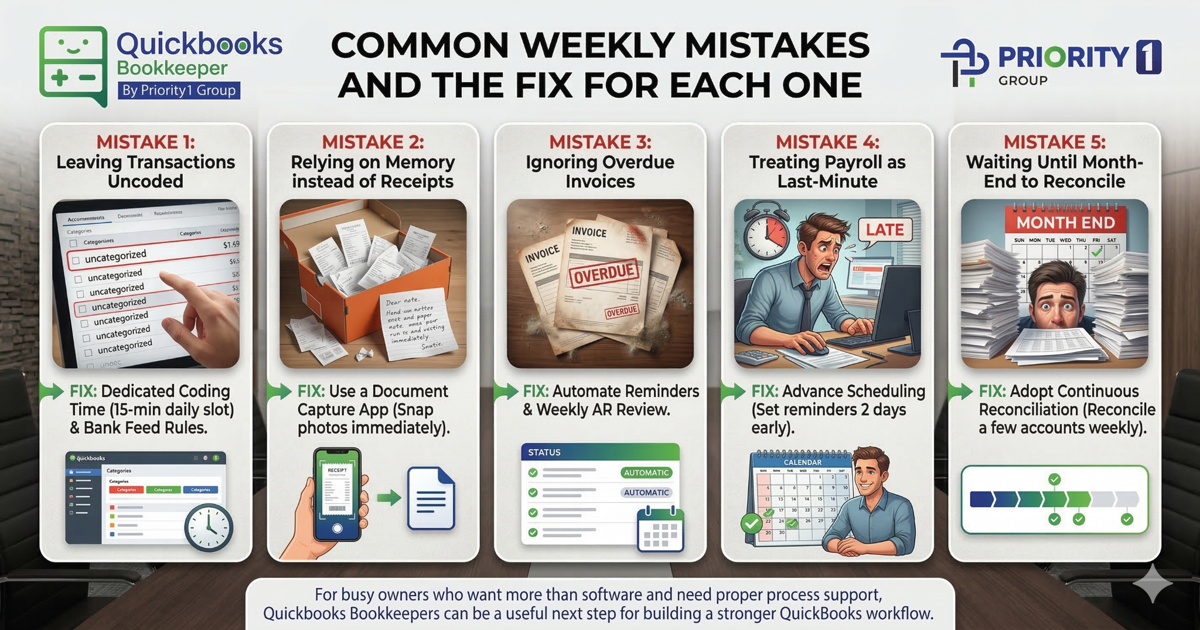
Busy owners tend to make the same mistakes, and thankfully the fixes are usually simple.
Fix: schedule one non-negotiable bank feed review every week.
Fix: capture and attach documents on the day the purchase happens.
Fix: make invoice follow-up part of your Tuesday routine.
Fix: review payroll, super, and coding before it becomes urgent.
Fix: do small weekly checks so reconciliation stays easy.
For owners who want more than software and need proper process support, Quickbooks Bookkeepers can be a useful next step for building a stronger QuickBooks workflow.
There comes a point where doing it all yourself stops being efficient.
A simple test is this: if bookkeeping keeps slipping because you’re too busy, too unsure, or too tired to deal with it properly, that’s your answer.
Good support should help you:
That might look like an Outsourced Bookkeeping Service, ongoing systems support, or regular oversight from someone who understands how small businesses actually operate.
That’s also why some owners move toward Priority1 Group when they want bookkeeping support tied to better systems, better habits, and less admin friction overall.
QuickBooks does not transform bookkeeping because it makes the hard stuff disappear. It transforms it because it makes consistency possible.
And consistency is what small business owners really need.
Not perfection. Not complicated reports. Not a finance degree.
Just clean books, clear numbers, and a weekly rhythm that helps the business stay steady.
If you’re ready to make bookkeeping feel more manageable and build a routine that actually sticks, Priority1 Group offers practical support, smarter systems, and ongoing help for growing businesses. Visit Priority1 Group to see how they can help.